
ANNUAL REPORT: 2025
1) Letter from the Board
The fifth year of our program was without a doubt our most eventful, most challenging, and most fulfilling year yet.
In February 2025, we welcomed 35 new undergraduates into our extraordinary community of Patti Grace Smith Fellows. Up to and Including our Class of 2025, we have brought 177 new superstars into the aerospace workforce and awarded them nearly $500,000 in cash grants to date. We’ve recruited these incredibly talented, passionate, and hardworking students from 77 colleges and universities around the United States, and helped them land their first aerospace jobs at 54 leading aerospace companies and institutions.
The cash grants, mentorship, job opportunities, and community that we provide to these deserving students are not only helping them get their feet in the door, they are also helping them stay: 80% of our alumni are continuing on in aerospace, with half of the remainder working in closely related fields such as robotics, nuclear energy, industrial operations, or academia.
In 2025, we also continued to strengthen our organization. Building on the strong foundation enabled by our historical partnership with the Brooke Owens Fellowship, we’ve worked to ensure the Patti Grace Smith Fellowship Foundation has the infrastructure and resources to continue to succeed for a long, long time to come. This year, we welcomed distinguished space policy leader Tahara Dawkins to our Executive Board, hired our first Operations Director, conducted our first ever fully independent Summit, and were awarded a generous grant from the Sachs Foundation.
That strength proved vital, as 2025 also marked a challenging year for every organization in the United States that sees the value of diverse perspectives and that believes it still takes work to give everyone an opportunity to show their talents and pursue their dreams. Many programs used 2025 to reevaluate or slow their work amid heightened national debate and evolving executive guidance related to diversity initiatives.
But, to paraphrase the Reverend Martin Luther King, Jr, the ultimate measure of a team is not where they stand in moments of comfort and convenience, but where they stand at times of challenge and controversy. We believed we could continue our work, and after consultation with legal counsel and completing appropriate due diligence, that belief has been confirmed by our success in recruiting incredible applicants and inspiring host companies for our Class of 2026.
The difficulty of our work stepped up a level in 2025, but we were more than ready to meet the challenge. We finish the year incredibly proud of our wonderful community of fellows, alumni, volunteers, mentors, partners, and supporters. And we look forward to an even better 2026!
2) Our Vision
We believe that the aerospace industry has global impact, global opportunities, and global responsibilities.
We believe that the aerospace community is always hungry for more talent.
We believe that inherent aerospace interest and talent are not unique to any one demographic.
We believe that abundant talent pools have gone untapped by the aerospace community.
We believe that aerospace teams continue to experience major challenges recruiting, selecting, training, and recognizing talent from communities that don't feel as connected to aerospace.
We believe that many students who have all the attributes necessary for successful careers in aerospace choose to pursue careers in other industries simply because the aerospace industry has not sufficiently pursued and connected with their communities.
We believe that many potential aerospace employees from underserved backgrounds depart the industry early in their college experience due to the lack of role models, the lack access to professional mentors, and the lack of near-term job or internship opportunities.
We believe that by addressing those lacking elements, we can help new cohorts of future aerospace leaders thrive in our industry, rather than depart it before truly beginning their careers.
We believe that if we are successful in that effort, we will simultaneously improve the career prospects of worthy individuals and enrich the entire industry by improving the overall talent pool.
3) About the Foundation
The Patti Grace Smith Fellowship Foundation seeks to meet the future needs of the U.S. aerospace workforce and to address underrepresentation of Black and African American individuals in the aerospace industry by connecting companies with highly talented prospective new entrants into the aerospace workforce, and by providing additional training and development opportunities to candidates as they begin their careers.
For our nation to maintain and expand our global leadership in aerospace, and for individual companies and programs to maintain competitive advantages over their peers, it is vital that they be able to recruit and retain candidates with the highest degree of individual merit, aptitude, work ethic, and determination. Numerous reports and comments from leaders in industry, academia, and government have highlighted significant challenges in maintaining a world-class workforce, noting the clear need to identify talent in areas that are currently underutilized and underrepresented. This includes the community of Black Americans, who make up 12% of the U.S. population, 13% of the overall U.S. workforce, and 11% of the US undergraduate student population, but only 7.2% of the overall aerospace and defense workforce, and only 5.2% of aerospace and defense engineers – an indication that there is a large pool of talented, hardworking, and driven Black undergraduates who have to date gone unrecruited by the overall U.S. aerospace workforce.
The Patti Grace Smith Fellowship Foundation sees in those numbers an opportunity to strengthen the workforce, to bolster our nation’s competitiveness, and to provide a fair chance to deserving students by identifying and recruiting top talent with a strong academic foundation and a drive to contribute meaningfully to the future of aerospace.
The Patti Grace Smith Fellowship was created in July 2020 by Will Pomerantz, Khristian Jones, Tiffany Lockett, and Alvin Drew. Our program adapted the proven model of the Brooke Owens Fellowship, of which Will Pomerantz was a co-founder and Khristian Jones an alum. From the creation of the program until 2024, we operated under the Brooke Owens Fellowship's 501(c)(3) non-profit entity. Now, we have our own Alabama nonprofit corporation, the Patti Grace Smith Fellowship Foundation. Over time, Tiffany Lockett and Alvin Drew have rotated out of their executive roles on the team, and Caleb Henry, AJ Bekoe (a previous Patti Grace Smith Fellow herself), and Tahara Dawkins have joined.
Our Fellowship is named after Patti Grace Smith, a beloved leader in the aerospace industry. In addition to her incredible aerospace career, particularly her vital role in enabling today's commercial space industry during her time as the head of the FAA's Office of Commercial Space Transportation, we were inspired by Patti's unbelievable personal story as a student who integrated public schools in Alabama during the height of the Civil Rights Era. We’re grateful to Patti’s family — Doug, Gene, Joyce, Simone, Wilma, and the rest — for allowing us to honor Patti in this way, and for sharing so generously of their memories of Patti.
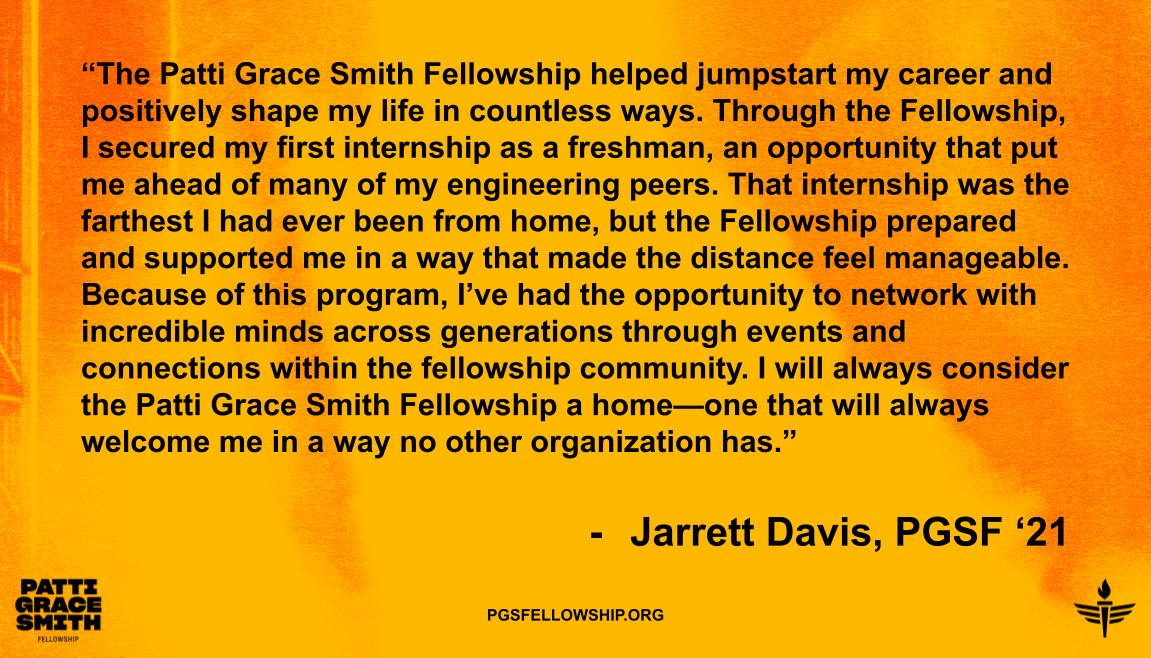
Through the end of 2025, our program has awarded nearly $500,000 in cash grants intended to help our Fellows further their academic and professional development, and helped 176 talented undergraduate students find their first steps towards careers in aerospace. Nearly all of our Fellows have come from historically underserved communities. Through our Fellowship, they are not only entering the industry, they are remaining and thriving: 80% of our alumni are now rising through the ranks of the aerospace industry, with an additional 10% in closely related industries such as robotics -- smashing the standard statistics for undergraduate programs.
We are incredibly proud of our Patti Grace Smith Fellows, and grateful for the role we get to play in helping inspiring aerospace companies connect with students and young professionals who possess extraordinary individual merit, aptitude, work ethic, and determination.
4) Our Programs
Patti Grace Smith Fellowship
Our primary program is the Fellowship for which we are named. The Patti Grace Smith Fellowship has a proven record of success helping companies meet their business goals and their workforce needs by attracting top-tier talent that is currently outside of the aerospace workforce. To do this, we use a system and method that has been proven to work again and again, across multiple different disciplines, demographics, and even nations. Here’s how it works.
First, we connect with great American companies and institutions doing incredible things in aerospace. If these companies are thinking about the future of their workforce, they believe in having robust internship programs that provide meaningful, challenging work to undergraduate students. Each year, we invite about two dozen of these companies to participate in our program by potentially hosting a Fellow (or multiple Fellows). Each company decides on their own whether to participate in this program. At this point, we have a waiting list of several dozen companies who have expressed an interest in hosting Patti Grace Smith Fellows.
Next, we connect with students and faculty members at colleges and universities around the United States. We seek to find students with incredible potential who are interested in aerospace but who are not yet in the aerospace workforce. Some of these students are just beginning their careers, while others may have gone back to school to start a second career,but none of them have worked in aerospace before.
Due to the export control laws and regulations applicable to the U.S. aerospace industry, all candidates must be U.S. Persons as defined by 22 C.F.R. § 120.17 and 15 C.F.R. § 734.13. We make a deliberate effort to raise awareness of the program and of aerospace career options in one of the populations that the U.S. aerospace industry historically has had the hardest time recruiting from, the Black and African American population. Students can be at any year in their undergraduate education, at any school, and studying any major, though they must have skills and interests relevant to working in some part of the aerospace industry (most commonly engineering or science, but also including policy, business, journalism, and other fields). And above all, they must be incredibly talented, the kind of students whose skills and work ethic will carry them to the top of any applicant pool. Whether they show that talent through their GPA, their extracurriculars, their independent projects, or anything else, the talent needs to be undeniably there.
After recruiting hundreds of applicants from colleges all across the nation, we then begin an extensive review and selection process. Our commitment is that every application is reviewed in full by two real human beings: we do not rely on any automated filters or simplistic keyword searches. In a typical year, every application receives at least an hour’s worth of attention and contemplation from aerospace professionals. On the basis of those reviews, we invite approximately 125 students to participate in interviews with our team. We use those interviews to assess each candidate’s professional aptitude, growth potential, leadership qualities, and community mindset. These interviews, all conducted by aerospace professionals, also help us identify optimal candidate-to-company matches. After we complete those interviews, approximately 75 candidates are invited to advance to the final step of our selection process.
In this final phase, each company that we have invited to participate in the program receives from us a small number of candidates to review — typically between five and ten. These finalists attained top-notch rankings after evaluations from three to eight aerospace professionals. What’s more, each candidate fit criteria to match with our partner companies, based on each company’s culture, projects, and priorities.
Each company then has a chance to review these applicants and to put them through their normal selection process. Many companies will have their candidates perform multiple rounds of technical interviews, submit examples of prior work, solve technical problems, and more. These candidates are being evaluated not only against each other but also against every other candidate who has applied for an internship directly.
No company is obliged to even interview any candidate, much less offer them a job. No spots are held, no standards are relaxed, and no bars are lowered. Patti Grace Smith Candidates must meet every threshold every other intern at the company meets, in addition to meeting all of the Patti Grace Smith Fellowship’s requirements. On occasion, a company will decline all of the candidates that have been presented to them, if they see better fits for their internship openings among their general candidate pool — but this is rare.
Once we have reviewed all of the hiring rankings and decisions from the companies, we will finalize our selection of that year’s class of Fellows. Each Fellow will be one intern among many at their host company, joining talented students from all backgrounds to contribute to exciting missions and projects.
With their internship secured, we then look to layer on other on-going services to each Fellow. First, we provide them with a cash grant of $2,500 that they can use to further their academic and professional development. These grants make a meaningful difference in the lives of our Fellows, who put the money to use by paying undergraduate tuition or graduate school application fees; purchasing textbooks, computer equipment, or professional attire to wear to job interviews; or in meeting the constant financial demands that accompany life as a student or an early-career professional.
Next, we provide mentors. We have seen firsthand how a good relationship with an excellent mentor can alter the trajectory of any person’s life. Mentors provide suggestions, ask tough questions, and help connect the dots. They can introduce an undergraduate student to new subjects, new resources, and new colleagues. They can help their mentees see where they are falling short and help them recognize where they are most powerful. Though it is possible to succeed without mentors, it is certainly a lot easier — and a lot more impactful — if you have a good mentor or two to guide you, especially at the start of your career.
Patti Grace Smith Fellows receive mentorship of the highest caliber. Each Fellow is paired with two mentors who have each agreed to spend at least two hours per month guiding our Fellows through their internships and their next steps. Our Fellows are paired both with executive-level mentors who have run our very industry, and with near-peer mentors only one rung ahead on the career ladder, each of whom has a different and extremely valuable perspective.
A major highlight of the program each year is our annual Patti Grace Smith Summit, during which we bring all of our Fellows to Washington, DC for four days of mentorship, bonding, and interaction with industry leaders. This year, our Fellows got to meet with spectacular aerospace professionals including Dr. John Mathers, NASA’s only Nobel laureate; Maj. Gen. Charlie Bolden, a four-time Space Shuttle astronaut and the former head of NASA; Gen. Les Lyles, the former head of the US Space and Missile Systems Center; and many others.
Because our Fellows complete their internships all around the country, the Summit provides a unique opportunity for members of each Class to bond with each other, in addition to professional networking. The summit also provides opportunities to see space and aviation hardware firsthand through trips to museums, factories, network operations centers, and other facilities relevant to careers in aerospace. PGSF Foundation executives, staff and alumni work together to run the summit.
At our 2025 Summit, we were also honored to welcome several members of our namesake’s family, who shared stories from Patti’s childhood and of lessons our Fellows could take from her leadership style, her career path, and her commitment to service.
In another first, many of our previous Fellows joined us at the 2025 Summit for a parallel Alumni Summit. With participation from Fellows across every year of our program to date, the Alumni Summit featured a mix of training opportunities, group brainstorms on current aerospace topics, and social events. By co-locating the Alumni Summit with the Class of 2025’s Summit, we fostered interaction and networking across the class years, with great success.
Our Other Programs:
Our Foundation was also able to secure several unique educational and professional opportunities for members of our extended community. These included:
Patti Grace Smith Scholarship. In addition to the scholarship that each Patti Grace Smith Fellow receives, we have also partnered with the Commercial Space Federation (commercialspace.org) to offer additional scholarship opportunities to undergraduate students. This year, two students were each awarded $2,500 scholarships, with awards presented as part of the annual 2025 Commercial Space Conference. Over the course of several years of collaboration with CSF, we have awarded a total of over $20,000 in scholarships and travel grants through this program.
Parabolic Flight Campaign. Thanks to the generous support of the Aurelia Institute (aureliainstitute.org), Anaelle “Elle” Roc (PGSF ‘21) experienced more than five minutes of microgravity as part of a parabolic flight operated by the Zero Gravity Corporation. During her flight, Elle recorded interviews and reflections of the experience, which were incorporated into a radio broadcast. As a current PhD in astronomy and astrophysics at Columbia University and as an aspiring space policy leader, Elle believes that innovative science communication is key to securing a better future for humanity in space. Elle was the sixth Patti Grace Smith Fellow to participate in a parabolic flight campaign with Aurelia.
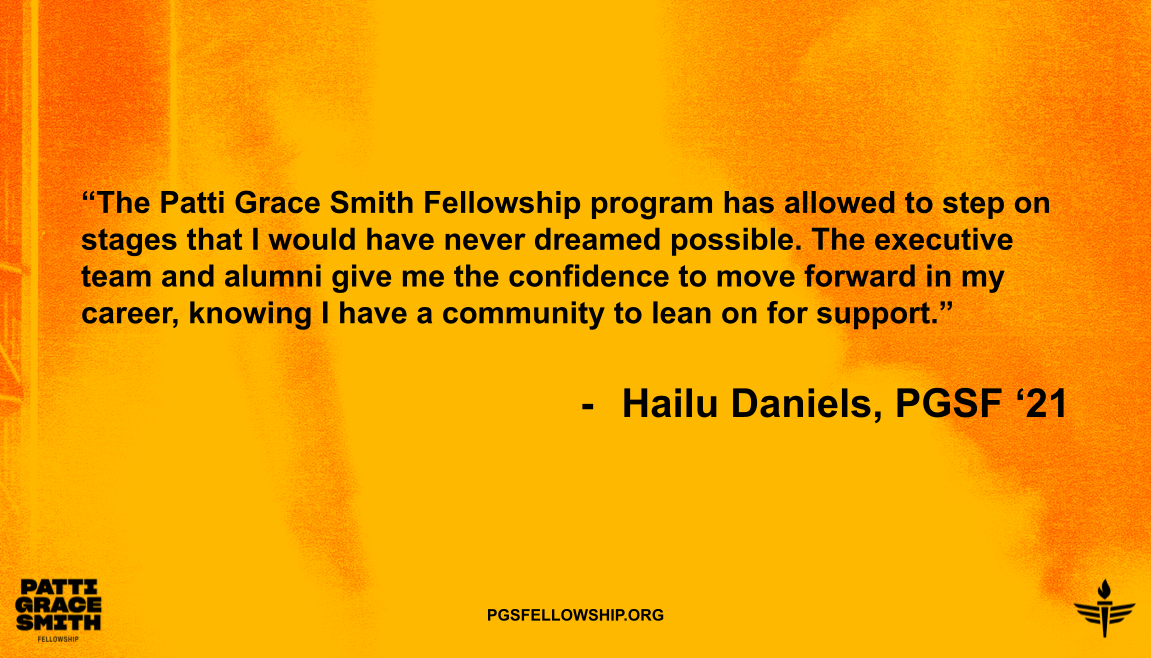
Space Symposium. For the fourth consecutive year, we partnered with the Space Foundation (spacefoundation.org) by providing two alums of our programs to serve as master moderators at the annual Space Symposium – the largest space conference in the US. Hailu Daniel (PGSF ‘21) and Spencer Roberts (PGSF ‘24) each made the most of their opportunity to shine on the biggest stage of the year.
5) Governance
The Patti Grace Smith Fellowship Foundation is led by a volunteer Board of Directors, also called our Executive Leadership Board:
Juanitta “AJ” Bekoe. PGS Fellow, 2022. Executive Board, 2024 - Present
Juanitta “AJ” Bekoe, is a Mission Systems Engineer at BAE Systems Inc. Space and Mission Systems (formerly Ball Aerospace, her host company), working on on-orbit spacecraft operations, verification and validation.
As an alumna of the fellowship program, she is eager to pay it forward and continue honoring Patti’s legacy by expanding the boundaries of the aerospace industry.
AJ is a graduate of Syracuse University, with a bachelor's degree in Aerospace Engineering and a minor in Physics. During her undergrad, she served as Vice President of her local National Society of Black Engineers (NSBE) chapter and the professional liaison for the local Society of Women Engineers (SWE) chapter. In both roles,she worked to facilitate an inclusive, opportunistic and engaging student experience for their members and engineering community at large. She is also passionate about advocacy in STEM education, having served as a mentor for young students in technical design competitions, and as a physics tutor for students at her university.
Tahara Dawkins. Executive Team, 2025 - Present
Tahara Dawkins has played a key role in shaping national and international space policy. She is currently the Director of Policy at Astroscale U.S., where she leads policy efforts on space sustainability and debris remediation.
Previously, she served as Chief of Staff for the White House National Space Council, where she helped coordinate space policy initiatives across federal agencies and the Office of the Vice President on national space strategy.
Dawkins also served as Director of the Commercial Remote Sensing Regulatory Affairs Office at the Department of Commerce, overseeing U.S. satellite imaging regulations.
Her expertise spans the civil, commercial, national security, and nonprofit space sectors, making her a valuable addition to the Patti Grace Smith Fellowship’s leadership team.
Caleb Henry. Executive Team, 2023 - Present
Caleb Henry is the Director of Research at Quilty Analytics, a boutique research firm focused on the satellite and space industry. He previously worked as a journalist for SpaceNews and Via Satellite, where he wrote about the commercial space sector for global audiences.
Caleb plays a lead role in guiding research projects, including speaking with industry executives, maintaining databases and writing reports. He is a frequently sought after public speaker, having appearances in Bloomberg, CNBC, the New York Times, and other major publications.
Caleb is a graduate of Grove City College, where he co-founded the group Students for Ethnic Awareness and Diversity, which provided a safe space for students to engage in communal reflection and reconciliation on matters concerning race, ethnicity, and culture. He has long had a passion for advocating for people of color in underrepresented environments.
As a kid, Caleb dreamt of being an astronomer, and he remains enthralled with the scientific understanding of space. Outside of work, Caleb is a distance runner, a middling Halo player, and an ardent defender of Jupiter as the best planet.
Khristian Jones. Co-Founder. Executive Team, 2020 - Present
A graduate of the Wichita State University Aerospace Engineering program, Khristian Jones is now an Interiors Engineer at United Airlines tasked with managing the Boeing 737 fleet. Previously, Khristian was a Material Test Engineer at Virgin Galactic.
As a child, she had a fascination with space and dreamt of one day having the opportunity to travel there. She decided at the tender age of fourteen that Aerospace Engineering just had to be in her future. Khristian did not discover her ambition for commercial spaceflight until college via an internship at The Spaceship Company. As an African American female with a passion for space travel, she never knew that something like being a commercial astronaut was achievable.
Khristian has always had a passion for STEM, but even more of a passion for showing young people that they can achieve a career in it. Growing up, there were not many role models for her to see that she could be a successful woman in a STEM field. Through her work at Engineering Outreach at Wichita State University’s SEEDS (Science Engineering Educational Development for Students) program, she discovered her passion for diversity advocacy in STEM. Khristian had a handful of work experiences in the Aerospace Industry as an undergraduate student. As a Brooke Owens Fellow, she interned at the Mojave Air and Space Port. She has also worked at Airbus Americas and Southwest Airlines.
Khristian now spends her time outside of her nine-to-five continuing to inspire other aspiring young STEM professionals and loves to speak on the advocacy for justice, equity, diversity, and inclusion in the aerospace industry. Although Khristian has transitioned to a role in the commercial aviation industry, she can never go too far from her love of space.
Will Pomerantz. Co-Founder. Executive Team, 2020 - Present
Will Pomerantz is an aerospace executive with two decades of leadership experience across the entrepreneurial and non-profit sectors. He currently serves as the Head of Space Ventures at AeroVironment, leading a business unit born from the team that developed the Collier Trophy-winning Mars Ingenuity helicopter in partnership with NASA JPL.
Will has spent his career at the intersection of commercial space and innovation. He was Employee #001 and Vice President for Special Projects at Virgin Orbit, and previously held the same VP title at Virgin Galactic. His career also includes serving as Senior Director of Space Prizes at the XPRIZE Foundation.
Beyond his executive roles, Will is committed to improving the future of the nation’s aerospace workforce. He is the co-founder of both the Brooke Owens Fellowship and the Patti Grace Smith Fellowship, award-winning programs that have provided internships, mentorship, and more than half a million dollars in cash grants to undergraduate students from underserved communities.
A graduate of Harvard and the International Space University, Will has served on two US Federal Advisory Committees and currently serves on the Boards of Directors for the Open Lunar Foundation and the Patti Grace Smith Fellowship Foundation, as well as the Advisory Boards of SEDS-USA and Space For Humanity. He lives in Texas with his wife, NASA Flight Director Diana Trujillo, and their children.
Will was proud to call Patti Grace Smith a friend, colleague, and role model. He is deeply honored to help carry her incredible legacy forward.
6) Class of 2025
Our fifth class Congratulations to you, we look forward to seeing you soar in your career!
Foladayo Akinbi, a Freshman at the University of Virginia studying Electrical Engineering;
Abi Areche, a Sophomore at the University of Michigan studying Aerospace Engineering;
Courtney Baker, a Sophomore at Lehigh University studying Mechanical Engineering;
Omoniyi Bankole, a Sophomore at Embry-Riddle Aeronautical University studying Aerospace Engineering;
Jaden Behringer, a Sophomore at Texas A&M University studying Aerospace Engineering;
Mariela Cepeda Santiago, a Freshman at the University of Puerto Rico, Mayagüez studying Mechanical Engineering;
Michaela Fuller, a Sophomore at Tuskegee University studying Aerospace Engineering;
Tyler Galloway, a Sophomore at Roanoke College studying Computer Science and Data Science;
Asaiah Gifford, a Junior at the University of Colorado Boulder studying Mechanical Engineering;
Khalil Harruna, a Sophomore at Georgia Institute of Technology studying Aerospace Engineering;
Josiah Hickman, a Sophomore at the University of Southern California studying Astronautical Engineering;
Noah Howell, a Sophomore at California Institute of Technology studying Mechanical Engineering;
McKenzie Jean-Baptiste, a Senior at Embry-Riddle Aeronautical University studying Software Engineering;
Jayson Johnson, a Junior at Howard University studying Mechanical Engineering;
Langston Johnson, a Sophomore at Cornell University studying Mechanical Engineering;
Michael Jordan, a Junior at Embry-Riddle Aeronautical University studying Homeland Security & Intelligence;
Sonia Kekeh, a Sophomore at Massachusetts Institute of Technology studying Aerospace Engineering;
Timothy "TJ" Kidd, a Freshman at Harvey Mudd College studying Engineering;
Lauren Leitch, a Junior at the Georgia Institute of Technology studying Aerospace Engineering;
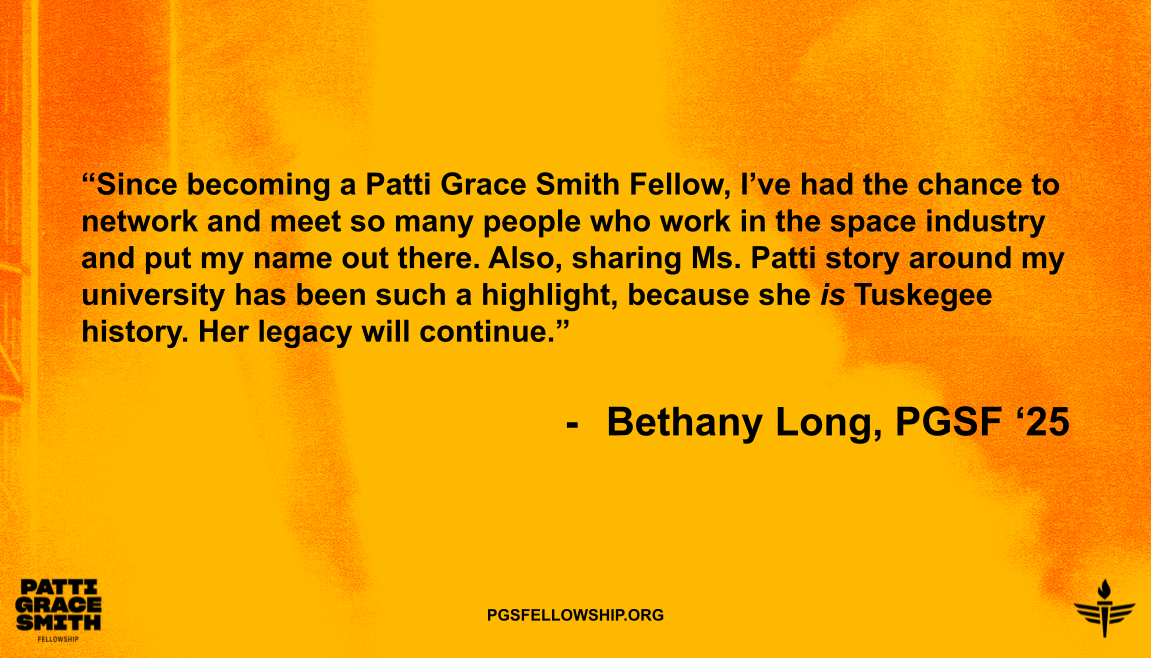
Bethany Long, a Senior at Tuskegee University studying Aerospace Engineering;
Chad McElroy, a Junior at Claremont McKenna College studying Government;
Fadhimah Mohamed, a Junior at Washington University in St.Louis studying Mechanical Engineering and Physics;
Tatiyyanah Nelums, a Senior at Syracuse University studying Aerospace Engineering;
Marquel Ollivierre, a Junior at Georgia Institute of Technology studying Aerospace Engineering;
Daniel Opara, a Senior at Tufts University studying Astrophysics and Computer Science
Jonathan Pierre, a Sophomore at Columbia University studying Mechanical Engineering and Applied Mathematics;
Ashton Pierre-Louis, a Junior at the University of Florida studying Aerospace Engineering;
Mersimoy Regassa, a Sophomore at Georgia Institute of Technology studying Aerospace Engineering;
Daniel Rojas, a Sophomore at Massachusetts Institute of Technology studying Aerospace Engineering;
Isabella Singleton, a Sophomore at Columbia University studying Mechanical Engineering;
Claudio Solano, a Senior at Columbia University studying Mechanical Engineering;
Alexis Tañón Martínez, a Sophomore at the University of Puerto Rico, Mayagüez studying Mechanical Engineering;
Jamar Whitfield, a Junior at Louisiana State University A&M studying Computer Science and Mathematics;
Xavier Williams, a Junior at Purdue University studying Astronautical and Aeronautical Engineering; and
Caleb Woldemichael, a Freshman at the University of Colorado Boulder studying Mechanical Engineering.
7) Financial Report
As a nonprofit, the Patti Grace Smith Fellowship Foundation efficiently manages operational expenses to ensure the greatest programmatic impact as we strive to achieve our mission of meeting the future needs of the U.S. aerospace workforce and addressing underrepresentation of Black and African American individuals in the aerospace industry.
Historically, our program has devoted between 54% and 99% of our contributions to programs. In 2025 specifically, 54% of contributions were devoted to programming, 23% to management and general operating expenses, and <01% to fundraising activities.
The Patti Grace Smith Fellowship was structured to have corporate partners who are employing “Patti” Fellows contribute an established rate of $5,000 to offset the costs of the program.
Our Foundations also benefits from donations large and small from members of the public and from philanthropic organizations. We are grateful for the sustained and vibrant partnership with the Brooke Owens Fellowship, with whom we shared some large donations while our then-brand-new program operated under the Brooke Owens Fellowship’s 501(c)3 entity, prior to the creation of our own. In addition to funding ongoing operations and growth, those shared gifts enabled us to establish an investment fund to accrue interest and to act as an endowment. That fund, which was split into separate funds for the BOF and PGSF in 2022, has performed well. Entering 2025, our investment account balance stood at $354,748.31; and by year’s end, it had grown by 14.6% to $406,870.85.
Those funds enabled us to bring on our first employee in 2025: Melissa Ximena Golebiowski joined us as our part-time Operations Coordinator in June. Melissa has been an excellent addition to the team, and has allowed us to continue to deliver the highest quality of programming while reducing volunteer fatigue and opening the opportunity for future growth of new programming.
Financial Highlights:
| INCOME | 2025 ACTUAL | 2026 PROJECTED |
|---|---|---|
| Program Service Revenue | $175,000 | $115,000 |
| Donations and Grants | $51,500 | $61,500 |
| Total | $226,500 | $176,500 |
| EXPENSES | ||
| Fellow Grants | $87,500 | $57,500 |
| PGSF Leadership Development Summit | $55,000 | $55,000 |
| Other Programming, incl. Alumni Support | $12,000 | $12,000 |
| Staffing | $15,000 | $20,000 |
| General Operating Expenses | $13,400 | $15,000 |
| Total | $182,900 | $159,500 |
| NET | $43,600 | $17,000 |